Before You Stack Novelty, Build the Ability to Settle
Brain Work & Behavior
You got a puppy. Congratulations — and also, sorry if someone has already handed you a socialization checklist or told you to find a puppy class immediately.
Somewhere between bringing your dog home and your first vet visit, you saw that checklist. Maybe the vet even gave it to you.
Expose them:
☑️ to children
☑️ to strangers
☑️ other dogs
☑️ traffic
☑️ umbrellas
☑️ men with hats
☑️ hardwood floors
☑️ elevators
☑️ the pub you go to all the time
Do it before twelve weeks. The window is closing. If you miss it, you'll pay for it later.
So you load your puppy into the car and take them somewhere new. They seem fine — a little wide-eyed, maybe — but they wag their tail, maybe even fall asleep right there, and you call it a win. You go home and check the box.
Here's what nobody told you: your puppy's nervous system may have been working very hard that day, and "seemed fine" is not the same as "was fine." The more you stack those outings without building something else first, the more you may be practicing the exact opposite of what you were hoping to achieve.
This isn't your fault. The advice you received is almost universally given and genuinely well-intentioned. But it rests on a foundation that is shakier than most people realize — and it is missing something essential.
Where This Advice Came From
The concept of a critical socialization window traces back to Scott and Fuller's landmark 1965 work, Genetics and the Social Behavior of the Dog — a twenty-year study conducted at the Jackson Laboratory in Maine. Their research demonstrated that early experience shapes social development in meaningful ways. That finding is real.
What often gets left out is what they were actually studying.
Scott and Fuller's experiments were largely deprivation studies. They isolated puppies from social contact during specific developmental windows and observed what happened. They found that dogs deprived of human contact during certain periods were difficult or impossible to socialize later. That is a meaningful finding about the consequences of severe deprivation — but it is not the same thing as a prescription for maximal exposure in normally reared puppies.
The leap from "deprivation causes lasting harm" to "therefore expose your puppy to everything before twelve weeks" is a larger inferential jump than it appears. A 2022 systematic review published in Animals confirmed that most socialization guidance given to pet owners today is still based on those same 1960s studies. The animal behavior field has produced very few experimental studies since, in part because designing rigorous experiments without socialized control groups is now considered unethical.
In other words, the cornerstone of modern socialization advice is a deprivation study that was never designed to answer the questions we're asking it to answer. The conclusions expanded well beyond what the research actually showed. And what grew in its place was the socialization checklist.
What Socialization Actually Is
Socialization is the process of helping a young animal form adaptive responses to novelty.
That requires two things: contact with the world, and the ability to recover from it.
Most socialization protocols focus almost entirely on the first half. The checklist is all exposure — new places, new people, new sounds, new surfaces. Recovery barely gets a mention, if it is mentioned at all.
The first thing to understand is that recovery is not the passive absence of stimulation. It is an active neurological process. It is the skill that allows a puppy to feel something, process it, and return to a settled state.
That settled state — what we call baseline, or homeostasis — is where learning consolidates and neural connections are strengthened.. It is where confidence gets built. It is where the nervous system files the experience as manageable rather than overwhelming.
Awareness, in our BASICS Framework, means reading both the environment and your puppy’s skills, or capacity, in that environment. Before a puppy can move toward the world with curiosity and confidence, they need a nervous system that knows how to come back from activation. Without that, you are not building socialization. You are building practice in staying activated, which is survival mode.
We are told to expose our puppy and ensure the experience is positive, but most people are not yet fluent in dog body language, so positive is hard to measure.
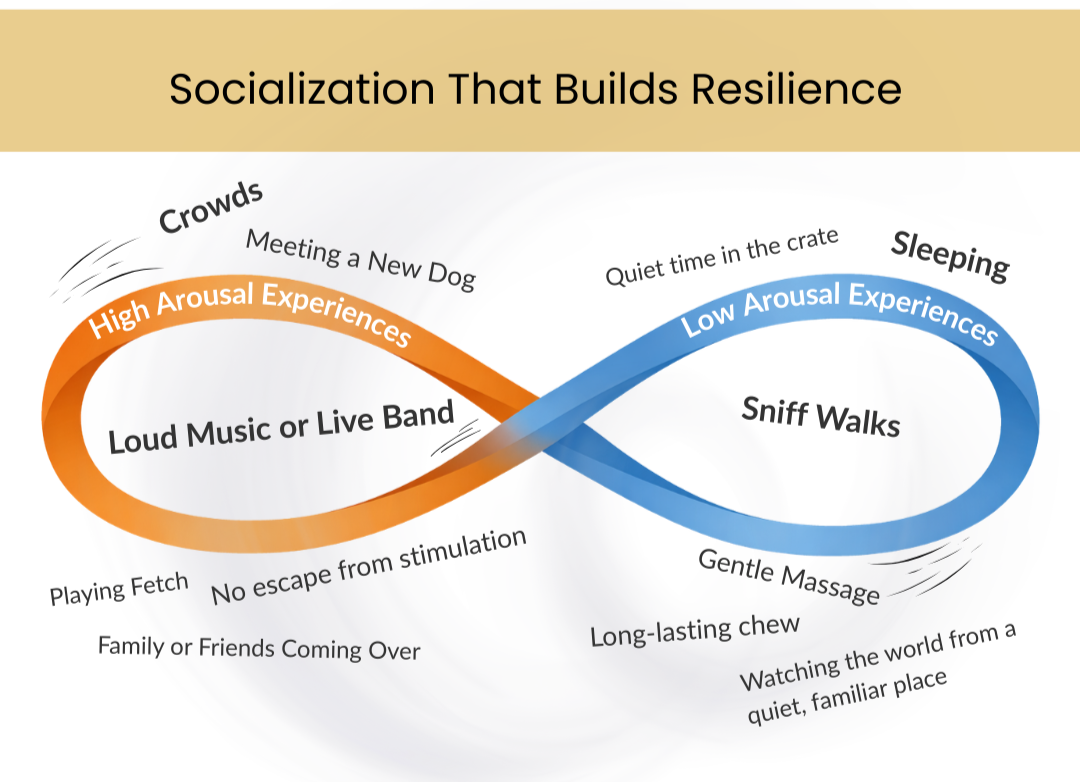
A more useful lens than even “is this a positive/good experience versus negative/bad experience" is this: think in terms of arousal.
High arousal experiences — new environments, meeting strangers, busy public spaces — require corresponding low arousal recovery. Rest. Quiet. Familiar surroundings. Undemanding time with someone they trust. The cycle of activation and recovery is what builds resilience. One without the other is incomplete.
The Sensitive & Fear Period Problem
The sensitive periods of development are real. These are developmental windows when the brain is more plastic and experiences wire faster, and more deeply, than they will later in life.
We have gravitated towards using the term “sensitive period” in research because it implies more graduation and flexibility than “critical period”, which has more finality and a hard open-and-close mechanism. However, the underlying concept is the same and it’s easily misinterpreted.
The timing of these periods varies across species, across breeds, and across individual dogs. There is no universal schedule in which "3 to 7 weeks" means one thing and "9 to 12 weeks" means another for every puppy. The windows are gradients, not cliffs. And the individual variation is significant enough that treating any timeline as fixed is already an oversimplification.
When you hear the term “fear period”, that is much more practitioner-driven language. It is meant to refer to the discrete windows - typically cited around 8—11 weeks and again around 6—14 months - during which a puppy is supposedly more likely to form lasting negative associations from a single bad experience. It’s essentially a sub-category that is layered on top of the sensitive period concept and the urgency it creates in owners is real and effective, even if the research isn't.
Early experiences matter.
The brain is genuinely more plastic during certain windows. But plasticity does not justify flooding that window with experience.
The tension that rarely gets named is that the window during which we're told to expose puppies to everything is the same window during which their brains are most sensitive to experience, including overwhelming or poorly timed experience. We are asking puppies to process high volumes of novelty during the exact period when they are most impressionable.
The experiences that wire fast during this window are not just the positive ones.
This does not mean you need to keep your puppy at home in a bubble. It means the quality, pacing, and recovery built around early experiences matter at least as much as the quantity of exposures. Possibly more.
What the Socialization Checklist Actually Produces
When socialization is treated as exposure without emphasis on recovery, something predictable happens — but it usually doesn't show up right away.
The puppy goes to the class. They go to the café. They meet the children and the strangers and the other dogs. They seem to handle it. They are young and adaptable and their stress responses don't always look like stress — they look like curiosity, or zoomies, or crashing hard the moment they get home.
Then adolescence arrives. The dog that seemed fine starts “reacting”. Owners report that the dog pulls towards other dogs or cowers from them. They can't settle in public. They scan constantly. They bark at things they used to walk past. They struggle in situations that should be familiar by now.
This is often the moment a trainer gets called. With a thorough intake, it is frequently traced back not to a lack of socialization, but to a nervous system that was asked to process more than it could integrate, repeatedly, during the window when it was most impressionable. The foundation that was supposed to be built was never actually built. What was practiced instead was overarousal.
Socialization that is treated as a checklist risks layering reactivity on top of immaturity. The dog was never given the chance to develop the regulation that would have made all those experiences useful.
What Recovery Actually Looks Like
Recovery is not complicated, but it is easy to skip when you're anxious about that checklist or about some mythical window of opportunity closing for good.
Here are two concrete examples of what it looks like in practice:
After any outing, give your puppy genuine downtime.
This is intentionally settled time. Not crated and ignored as a punishment because they're biting or have stopped listening, but intentionally settled in a crate or quiet room as a familiar low-demand place to decompress.
Twenty to thirty minutes of low stimulation after a high stimulation experience is not wasted time. It is when the nervous system integrates what just happened as manageable.
That processing is socialization.
Watch for the signs that your puppy is full before they tip over.
Yawning, lip licking, looking away, losing interest in food they normally love, moving slowly or clumsily are not signs of boredom. They are signs of a nervous system working hard.
When you see them, the answer is not hoping they get used to it and work it out on their own. The answer is looking for the shake off (literally, the puppy shaking their head or whole body like they are getting out of a water pool), reinforce them for disengaging or leaving a situation, then giving them a quiet place and a chance to settle.
Ending on that note is building exactly the skill your puppy needs most: resilience.
A Different Goal
The goal is not a puppy that has experienced hundreds of things by sixteen weeks of age.
The goal is a puppy that can feel something, process it, and come back to baseline. That capacity for regulation and resilience is what eventually supports everything else you're imagining: the café, the trail, the group class, the family gathering. None of those things work well without it.
Tear up the checklist. You need a puppy that knows how to settle.
That is where we start.
This is part of an ongoing series on Brain Work & Behavior. The next post will look at what happens when the rules change — and why the gap between puppy behavior and adolescent expectations is one of the most overlooked sources of behavioral fallout we see in practice.
Casa Luna Canines is your partner in dog training, human learning. Join us to learn how to be your dog’s best friend using 100% pain and fear free methods. Imagine what it will feel like when your dog chooses to behave well around you, no matter where you are!